
Why We Recommend Philips AEDs: A Frontline Perspective from ShockShop.ca
2026 Oct 17th
Sudden cardiac arrest waits for no one, whether you are cooking dinner at home, cheering for your child’s hockey team at the rink, or taking a break at the office cafeteria. Every minute that passes without defibrillation decreases the chances of survival by roughly seven to ten percent, with emergency services in most Canadian communities only managing to arrive at the front door within seven to twelve minutes. This is why a defibrillator in the room is always better than the best paramedic team in the city, which has to drive for half an hour before it can do its job.
This is the rationale behind any public or home automated external defibrillator, the life-saving equipment that can buy critical minutes before emergency medical services arrive.
However, not every AED brand manages to bridge the treatment gap in the same way, and our years of firsthand experience with these devices have enabled us to compile a list of qualities that set the best apart from the average.
What Sets a Good AED Apart From an Adequate One
The fundamental functions of all automated external defibrillators are rather similar – analyze the patient’s heartbeat to determine whether a shock is needed and guide the rescuer through the procedure for delivering it. However, the practical implications of this seemingly simple task can differ significantly, as those who have had to use an AED in real life will certainly tell you.
First, the instructions need to be clear, concise, and easy to understand, even for someone who has never operated the device (a fairly common occurrence during a cardiac emergency).
Second, the placement of the pads usually dictates the pace of CPR, which makes intuitive guidance even more important. In addition, an AED should be simple to use and only require minimal maintenance between deployments, as devices that see little regular use rarely get the same level of care as those always available at the hospital.
Finally, most importantly, the AED must be completely reliable right when and wherever it is needed, with minimal regular upkeep required in between.
Where Philips AEDs Consistently Perform
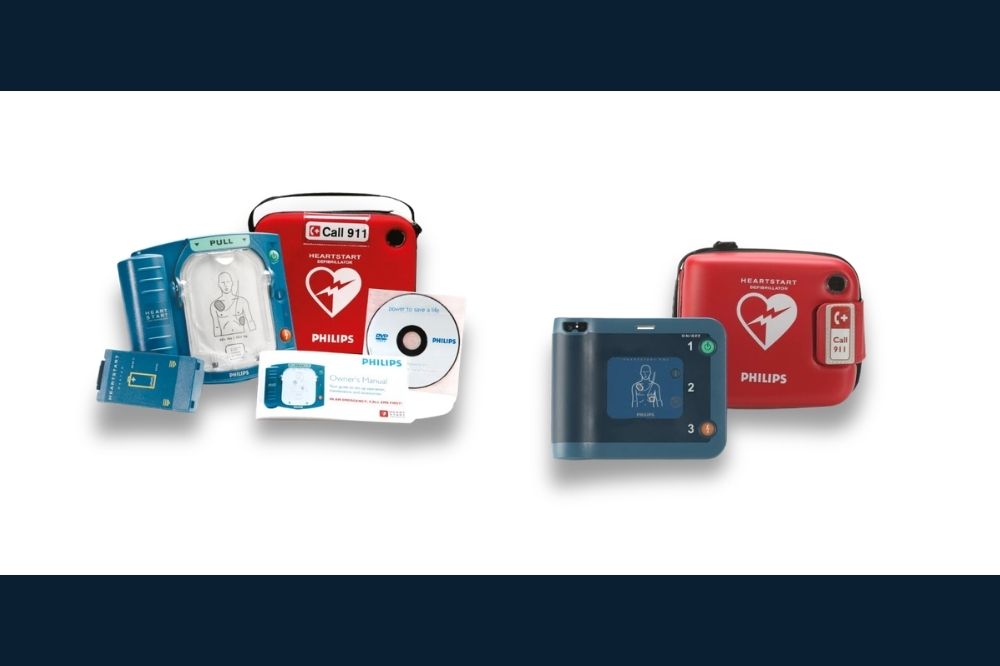
Several particular strengths set Philips’ life-support devices apart from the competition and prompt us to recommend them to our clients more consistently than any other brand.
- First off, Philips AEDs use uniquely easy-to-follow voice instructions; they let the rescuer know what to do next and understand, not read, complicated text or function explanations. This is a great benefit when dealing with an unfamiliar device during an overwhelming, panic-stricken crisis!
- The second Philips design is intuitive, reducing opportunities for user error and speeding up CPR while causing less trauma in an already panicked situation. Philips uses a single-lead ECG with large, easy-to-see label guides to reduce cognitive load for rescuers!
- The self-tests built into Philips devices are designed to be comprehensive yet rarely accessed, with minimal regular maintenance needed before the next use.
- Battery and pad longevity are key to ensuring an AED Philips is ready to use at any time, and Philips’ official documentation provides transparent information on the expected lifespan of each device. Lastly, the AED’s durability is optimized, allowing it to withstand a variety of environmental challenges that a person using it at home may subject it to.
- In particular, extreme temperatures that would affect other brands are not a problem for Philips devices, which is a significant consideration for any Canadian climate.
AEDs for the Home: Becoming More Common but Still Rare in Canada
Home defibrillators are still less common in Canada than in the United States, but they are appearing with increasing frequency in Canadian households. At the most basic level, there are several reasons why a family may choose to purchase an automated external defibrillator. First, a cardiac emergency can occur anywhere, at any time, and a family with a sick elderly member, for example, is always at risk.
In the last decade, AEDs have undergone significant technological downsizing; they are now smaller, easier to use, and more affordable than ever before. For all these reasons, more Canadian families are choosing to buy a defibrillator to keep at home and be prepared just in case.
Weighing Your Options for an AED for the Home or Workplace
For families and businesses alike, every situation is unique, which is why we offer our clients our personal insight and experience to help them decide what is most important to them. A family with small children and a sick elderly member has completely different requirements from a young couple just moving into their first apartment. It is always essential to start with the basics: the fundamental aspects of owning and operating a defibrillator that apply to all households and are always important to consider. It is also crucial to keep in mind that any decision to purchase an AED is personal; after all, these devices have the potential to save your own family.
Shock Shop is here to help you choose the best AED for your household or workplace. We always begin with your unique requirements and provide an honest evaluation of what options are best suited to your capabilities. If you are considering buying a Philips AED for the home or the workplace and simply seeking an unbiased opinion based on our years of firsthand experience, let’s talk soon.