
Can a Home AED Save Lives Before Paramedics Arrive?
2026 Oct 14th
When a sudden cardiac emergency occurs, each second feels like an eternity. You call 911, get reassurance that emergency medical services (EMS) are on the way, then the agonizing wait begins.
In Canada, even with the highly efficient system of emergency response in this country, the geographical, traffic-induced, or rural realities of our nation dictate a delay between a 911 call and the physical arrival of paramedics. Time is the absolute most critical factor affecting the survival of a Sudden Cardiac Arrest (SCA) victim.
This makes it a crucial consideration for Canadian households: can a home AED save lives before paramedics arrive?
The simple and resounding answer to this question is unequivocally yes. By understanding the science of cardiac arrest, the realities of emergency response, and how access to a defibrillator alters the survival equation, we see why it's becoming an essential item to have in homes across the country.
The Race Against the Clock: Understanding Cardiac Arrest
Knowing the difference between sudden cardiac arrest and heart attack will help one understand why having a home AED in Canada is important. That is why a heart attack which is a "plumbing problem" where blood flow is blocked due to a clogged artery whereas sudden cardiac arrest which is an "electrical problem" - the heart's electrical signals are going haywire making the heart to either quiver or stop beating altogether.
When this happens, the heart can no longer pump oxygen-rich blood to the brain and other essential organs. The person will fall unconscious and stop breathing normally.
While performing CPR manually pumps a small amount of blood to the brain, it is not capable of restoring a normal heart rhythm. The only definitive treatment that will reset the heart to its regular rhythm during a shockable SCA event, which in most SCA is ventricular fibrillation, is an electrical shock delivered from a defibrillator.
Bridging the Gap with a Home AED in Canada
This critical multi-minute span between dialing 911 and hearing the sirens is precisely why a home AED Canada device is a life-saving investment.
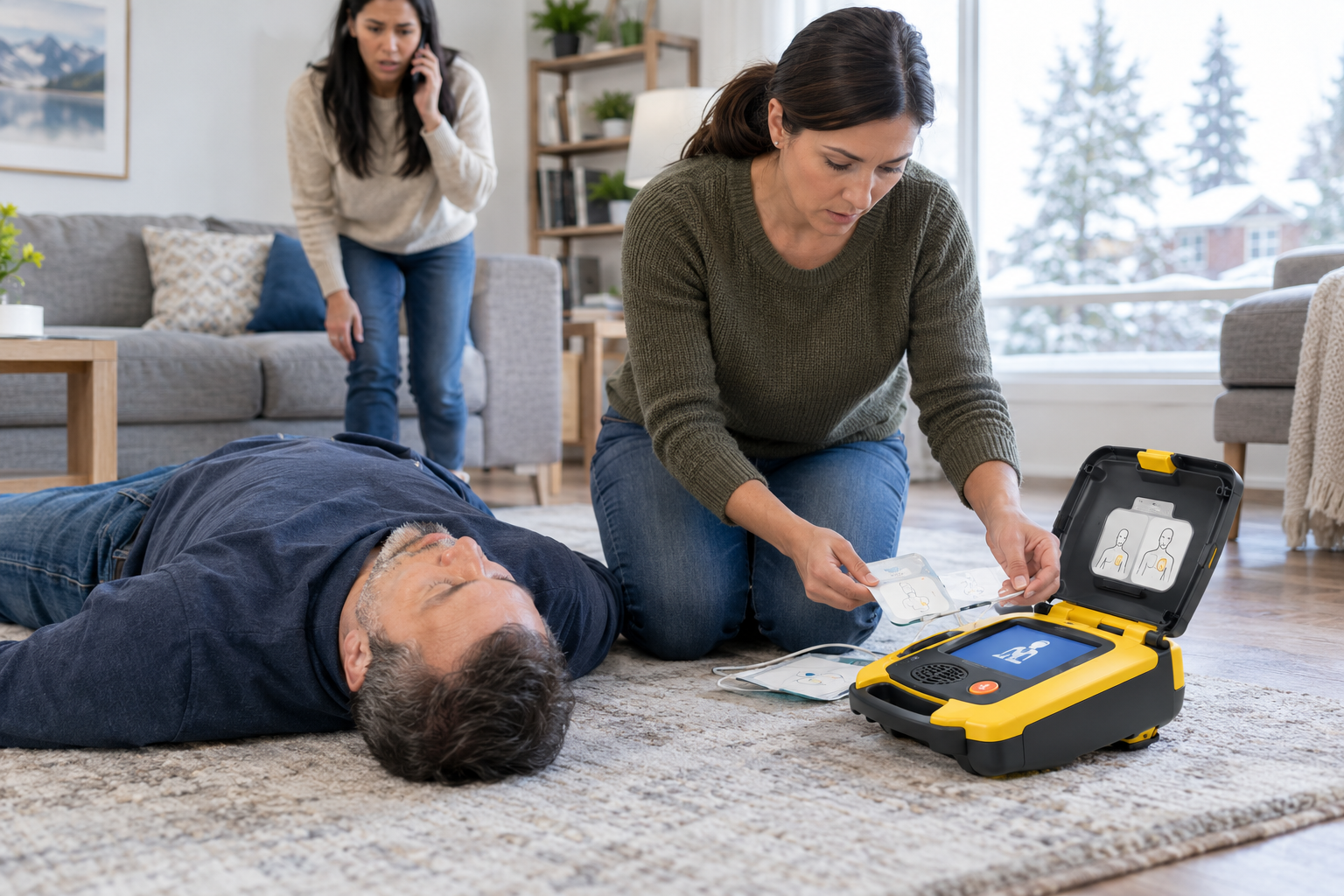
A Health Canada-approved defibrillator, securely wall-mounted or tucked away in an easily accessible closet, virtually eliminates this transit delay. Instead of waiting, on average, 8 minutes to receive a shock, the user or a bystander can deploy the device within 2 minutes of a cardiac event.
At Shock Shop, we are committed to providing Canadian families, remote homes, and small businesses with the same medical-grade technology that emergency medical professionals rely on, but in a version safe and accessible for the layperson. This ensures that an ordinary person can use modern home defibrillators during an extraordinary event – no extensive medical training or specialized degree required.
How a Home Defibrillator Guides You Step-by-Step
When it's opened or powered on, a clear, automated voice leads you through the entire process, clearly indicating each step.
Clearly marked diagrams illustrate the proper placement of electrode pads on the patient’s chest.
Once applied, it automatically analyzes the heart rhythm and delivers an electrical shock only if the detected rhythm is a lethal, shockable rhythm. It is physically impossible to deliver a shock if it is not required.
Built-in metronomes provide rhythmic guidance to maintain an adequate depth during chest compressions until paramedics arrive to take over.
The Good Samaritan Protection
A common anxiety amongst Canadians is legal liability when administering emergency aid. With Good Samaritan Legislation enforced in every Canadian province and territory, individuals providing emergency first-aid using an AED in good faith will be legally protected from any civil liability.
Key Considerations for Canadian Homeowners
What Canadians need to consider when shopping for their home AED Canada solution:
- Environment Durability: If you will be storing a device in a remote lake cottage, or an unheated garage, consider the IP rating (Ingress Protection) against dust and moisture, as well as temperature limitations of the device.
- Child Use Customization: Sudden Cardiac Arrest can affect all ages. Select a device that either has a dedicated child function, or the capacity for child-specific electrode pads, which will automatically lower the power output of the electrical shock to a safe level for children under the age of 8 and weighing less than 55 lbs.
- Automated Maintenance Checks: High-quality home AED units perform automated self-checks daily, weekly, or monthly, depending on the device, to verify that internal circuitry and electrode pad gel are functional. A clear status indicator light confirms if your device is ready to go.
Conclusion
While paramedics do a remarkable job across Canada on a daily basis, there are instances when they cannot beat the clock when a heart has stopped beating within the confines of a private home. An AED in the home acts as an essential life-support bridge between a collapse and the arrival of emergency services. By investing in this life-saving equipment, Canadian families can be prepared not only to wait helplessly but to act decisively to protect those dearest to them.